Blog

  /  

Electric Fireplace Running Costs and Energy Efficiency Guide

Electric Fireplace Running Costs and Energy Efficiency Guide

Most people who choose an electric fireplace choose it for the flame first. The question of what it costs to run follows, usually on the way home from the showroom. The flame is the reason to buy. The electricity bill is the reason to hesitate. That gap is far smaller than it feels.

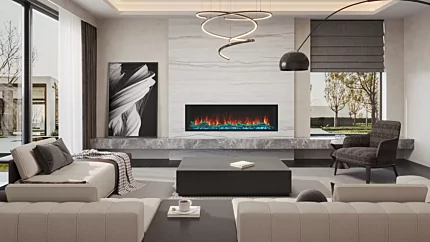
An electric fireplace costs very little to run when used for ambience and a manageable amount when used for heat, because the flame effect and the heating element draw power completely independently of each other. Run the flame on its own and you are paying for something close to a household light bulb. Switch the heat on and you are paying for a 1,500-watt heater, which is a different conversation but still a predictable one. The electric fireplace running cost you actually live with depends almost entirely on which of those two modes you spend your evenings in. EcoSmart Fire's Motion and Switch collections, installed in homes and hotels across more than 75 countries, are built around exactly that dual-mode logic.

Published:
· Updated:

How much does an electric fireplace cost to run?

Loading image...
thumbnail: webimage-Switch-56SS-Electric-FireplaceSwitch 56SS - Residential Space CGI

The honest answer is a tale of two numbers. On flame only, the running cost is close to negligible. With the heating element on, it sits in the same range as any other portable plug-in heater.

The brand-stated figures for the Motion range put this in perspective: roughly 2 cents per hour for the flame effect alone, and around 24 cents per hour with the heating element running at 1,500 W, based on the average US residential electricity rate. Those two numbers bracket almost every way you might use the fireplace. A quiet evening of flame-watching in spring costs a few cents. A cold January night with the heat on for four hours costs around a dollar. Neither is the kind of figure that should decide whether you buy something you want to look at every day.

What makes electric different from a fuel-burning fire is that the cost is entirely yours to set. There is no minimum burn, no pilot light, no fuel you have already paid for sitting in a tank. You pay for exactly the mode you choose, for exactly as long as you choose it. The contemporary electric models in our range are built around that dual-mode logic, so the decision to run warm or run cool is yours to make every single night.

Understanding electric fireplace electricity usage

Electric fireplace electricity usage comes down to three things multiplied together: how many watts the unit draws, how many hours you run it, and what your utility charges per kilowatt-hour. Get a feel for those three and you can estimate any scenario yourself.

The number that surprises people is how little the flame effect draws. Across our electric ranges, the LED flame system pulls between 30 W on the smallest screen and 106 W on the largest, comparable to a standard household light bulb left on. That is the whole cost of the look. The heating element is the part that moves the bill, and it draws independently of the flame.

What is the running cost of an electric fireplace? It is the sum of two separate loads. The LED flame effect is a fixed, low draw that scales gently with screen size. The heating element is a fixed high draw, either 1,500 W on a 120 V circuit or 3,000 W on a 240 V circuit, and it is the same regardless of which model you choose, because heat output is set by voltage, not screen width. One model is not cheaper to heat with than another; they all share the same heating draw.

A quick way to think about the bands:

  • Flame only: a small, light-bulb-scale draw. Pennies per hour at typical rates.

  • Heat on at 120 V: a 1,500-watt load, the cost of running a standard plug-in heater.

  • Heat on at 240 V: a 3,000-watt load, double the heating capacity for rooms that need it.

The mechanics behind that LED flame, the layering and projection that make it convincing, sit outside the scope of running cost. What matters for your bill is simply that the flame and the heat are billed separately, and the flame is the cheap half. If you want to dig into model widths and screen sizes, the electric fireplaces collection lays the range out side by side: look to Motion for panoramic inserts and to Switch for compact wall installations.

Running cost per hour, per month, and per year

The takeaway before the numbers: how you use the fireplace matters far more than which model you own. Three households with the same unit can land in completely different places on the bill, depending on whether they run it for heat, for evening warmth, or purely for the flame.

The figures below use the brand-stated indicative rates for the Motion range (around 2 cents per hour flame-only, around 24 cents per hour with 1,500 W heat) at the US average residential rate, so they are illustrative rather than a quote for your own utility.

Usage pattern

Per hour

Per month

Per year

Flame-only ambience, 4 hrs/day

~2 cents

~$2.40

~$29

Moderate evening use, heat on 3 hrs/day in season

~24 cents

~$22 (winter months)

~$65 (heating season only)

Heavy use, heat on 5 hrs/day through winter

~24 cents

~$36 (winter months)

~$110 (heating season only)

Two things jump out. First, the flame-only line is so low that running the fireplace every evening of the year for its look costs less than a single takeaway coffee a month. Second, the heating figures only apply during the months you actually want heat, so the annual total is far smaller than multiplying a winter month by twelve. Among the modern electric fireplaces we offer, the running cost is shaped almost entirely by how many of your hours are flame-only versus heat-on.

Why running cost varies by market

The same fireplace, drawing exactly the same wattage, costs different amounts to run depending on where you plug it in. Electricity prices vary widely, and that variation, not the appliance, is what moves your bill between countries.

A few reference points from official statistics put the spread in context. The US Energy Information Administration recorded an average residential electricity price of 16.48 cents/kWh in 2024. In the UK, the Ofgem price cap for Q3 2025 set a rate of 25.73 pence/kWh for Direct Debit customers. Across the EU, Eurostat reported a household average of €0.2872/kWh in the second half of 2024, with a striking range from around €0.10/kWh in Hungary to nearly €0.40/kWh in Germany. Canada sat near 21.71 cents/kWh on average, with wide provincial variation.

Market

Indicative residential rate

What it means for running cost

United States

~16.5 cents/kWh (2024 average)

Lowest of these four; flame-only stays in the low-cents range

Canada

~21.7 cents/kWh (2024)

Varies sharply by province

United Kingdom

~25.7 pence/kWh (Q3 2025 cap)

Heat-on cost noticeably higher than the US

European Union

~€0.29/kWh average (H2 2024)

Country spread is enormous, so local rate matters most

The practical lesson is to run the brand-stated cents-per-hour logic against your own local rate rather than a national average. Our electric fireplaces, including the Switch range, which is designed for sheltered outdoor spaces under cover, are available across these markets, so the question is never whether you can run one where you live, only what your utility charges to do it.

Are electric fireplaces energy efficient?

Yes, at the point of use an electric fireplace is as efficient as a heater gets. The US Department of Energy is explicit that electric resistance heating converts essentially all the incoming electrical energy into heat, with nothing lost up a flue. Every watt you pay for ends up warming the room.

That point-of-use efficiency is exactly why electric fireplaces work so well as zone heaters. Instead of warming a whole house to keep one room comfortable, you heat the room you are actually sitting in and let the central system idle. The Department of Energy notes that zone heating this way can cut energy use by more than 20% compared with heating the entire floor area of a home. Given that space heating accounts for the largest single slice of household energy, that is a meaningful lever.

A few factors shape how efficient the experience feels in practice:

  • Room coverage. Across our electric ranges, a single unit is rated to warm around 28 m² [300 ft²] on a 120 V circuit and up to 56 m² [601 ft²] at 240 V. Match the unit to the room and you avoid paying to overheat.

  • Supplemental, not central. The manufacturer positions these as supplemental heat for the room you occupy, not a replacement for a whole-home system. Used that way, they save money; used to heat a draughty open-plan space alone, they work harder than they should.

  • Keep the vents clear. A blocked air path makes the unit work without delivering heat to the room, so a clear front is part of running efficiently.

The honest caveat is that efficiency at the wall does not always mean the cheapest energy unit. Electricity is a higher-cost fuel per kilowatt-hour than some alternatives in some markets, which is exactly the trade-off worth weighing before deciding how the running cost of one of these energy-efficient electric fireplaces fits your home. That is the trade-off the next section addresses directly, and for a design-first purchase, the installation savings often close that gap before the first bill arrives.

Electric versus gas versus bioethanol running costs

Here is the comparison most buyers actually want and few sellers can make honestly, because most sell only one technology. The experiential headline: electric is the cheapest to install and the simplest to live with, gas tends to be the cheapest per unit of heat where gas is affordable, and bioethanol sits in between with the least infrastructure of any real-flame option.

Factor

Electric

Gas

Bioethanol

Running cost per hour

Low on flame, moderate on heat; tracks your electricity rate

Often the lowest cost per unit of heat where gas is cheap

Set by fuel price; flame and heat are inseparable

Installation and infrastructure

Plug-in or hardwired to a dedicated circuit; no flue, gas line, or hearth

Needs a gas line and usually a flue or venting; professional install

No flue, no gas line, no fixed plumbing

Cost of ownership notes

Most predictable; bill is fully under your control

Lower fuel cost offset by higher install and servicing

No install cost, but you pay for fuel every burn

Over five years, the electric case often narrows or reverses once installation, servicing, and infrastructure are factored in, costs that the plug-in format sidesteps entirely.

The trade-off is really about where you want to spend. Electric front-loads almost nothing and keeps your ongoing cost transparent and adjustable, since you can drop to flame-only any time the heat is not wanted. Gas can be cheaper to run in markets with low gas prices, but you pay for that in the flue, the gas line, the hearth, and the servicing that the technology requires. Bioethanol avoids the infrastructure entirely and gives you a real flame, with the running cost living in the fuel rather than the wall.

For a design-led purchase, the deciding factor is rarely the cents-per-hour line. It is whether you want to run a gas line and a flue through your wall at all, and whether you want the fire to be usable in summer with no heat. On both counts, electric asks the least of the building, which is part of why the wall-mounted electric fireplaces install where a fuel fire simply could not go.

The low-cost case for flame-only ambience mode

This is the use case that quietly justifies the whole purchase, and almost nobody talks about it. Run the fireplace for its look alone, heat switched off, and the cost is so small it stops being a factor in whether you turn it on.

On both our electric ranges, the flame runs completely independently of the heater. Set the Motion to its H0 state and the heater and blower switch off entirely while the flame display keeps going; cycle the heat off on a Switch, and you get the same result: flame alive, element cold. At that setting the unit is drawing the light-bulb-scale LED load, which is why the brand-stated flame-only figure lands near 2 cents per hour.

A fire you can run every evening of the year for roughly the cost of leaving a lamp on changes what the fireplace is for. It stops being a winter appliance and becomes everyday atmosphere.

That is the real shift. A wood or gas fire commits you to heat whether you want it or not, which is why most fireplaces sit dark for two-thirds of the year. A flame-only electric fire has no such penalty. On a mild spring evening, in a warm climate, or in a room that is already comfortable, you light it for the glow, and the bill barely notices. The freestanding electric fireplaces in our collection are designed to live in the room all year, not to be packed away with the heater when the season turns.

Loading image...

thumbnail: webimage-ESF-EL40-Renovation-Aloha-HGTVEL40 Renovation AlohaHGTV

How to reduce your electric fireplace running costs

The levers that cut your bill are mostly about habit, not hardware. A few deliberate choices keep the running cost firmly in the modest range.

  • Run the flame without the heat switched on whenever the room is already at a comfortable temperature. This single habit moves most of the bill, because the flame costs a fraction of the heated mode, so the heating element earns its keep only in the hours and months you actually want warmth.

  • Lean on the timer. Both ranges include an auto-shutoff timer, so the heater stops on its own rather than running into the small hours, and on the Motion range you can set shutoff from half an hour upwards.

  • Heat the room you are in rather than the whole house. Zone heating means you stop paying to warm empty rooms, so drop the central thermostat a degree or two and let the fireplace carry the room you occupy, the strategy the Department of Energy credits with 20%-plus savings.

  • Right-size the unit to the room. The range is rated for up to 56 m² at 240 V and is most efficient when matched to that footprint, so a model sized to your room reaches comfort without running flat out.

  • Shift heat-on hours to off-peak where you can. If your utility offers a time-of-use tariff, running the heater in the cheaper window helps. In the UK, Economy 7 tariffs price an overnight period lower; many US and Canadian utilities offer similar time-of-use plans, though the specifics vary by provider.

  • Pair it with your own renewable electricity. If you have rooftop solar, flame-only running during daylight can lean on your own generation, and even the heated mode draws from cleaner power. Because the units run zero-emission at the point of use, with no smoke or combustion gases, pairing them with renewable supply is a genuinely low-impact way to keep a fire going.

One smaller note worth knowing on the Switch range: when wired for 120 V in North America, the Low and High heat settings deliver the same output, so selecting Low does not save electricity at that voltage. At 240 V the Low and High heat modes become distinct, which is worth knowing when specifying the circuit. It is the kind of detail that saves you fiddling with a setting that is not doing anything.

Frequently asked questions

How much electricity does an electric fireplace use on flame only?

Very little. The LED flame system across our ranges draws between 30 W and 106 W depending on screen size, comparable to a household light bulb, which works out to roughly 2 cents per hour at the US average rate based on the brand-stated Motion figures.

Does an electric fireplace cost a lot to run with the heat on?

The heating element draws 1,500 W at 120 V or 3,000 W at 240 V, the same as a standard plug-in heater, so the cost depends on your local electricity rate and how long you run it. The brand-stated figure for the Motion range is around 24 cents per hour at 1,500 W on the US average rate.

Is it cheaper to run an electric fireplace than central heating?

Often, if you use it for zone heating. Warming only the room you are in, rather than the whole house, can cut energy use by more than 20% according to the US Department of Energy, which is why electric fireplaces work best as supplemental heat rather than a primary system.

Do electric fireplaces use a lot of electricity if left on all day?

On flame only, no. The flame effect draws a light-bulb-scale load, so running it through the day for ambience adds very little to your bill. The cost only climbs meaningfully if the heating element is left on.

Why does my electric fireplace cost more to run than my neighbour's?

Almost always because of your electricity rate or your usage pattern, not the unit. Heat output and flame draw are fixed by voltage and model, so two identical fireplaces cost different amounts to run wherever local rates or heat-on hours differ.

Making electric fireplace running costs work for your home

Strip away the worry and the picture is simple: the running cost is a choice rather than a fixed expense. An electric fireplace is cheap to look at and predictable to heat with, and you control the dial on both. The flame costs about as much as a lamp, the heat costs about as much as a portable heater, and nothing about the bill is fixed in advance the way a tank of fuel or a gas standing charge would be.

That is what makes the design-led case so easy. The flame and the heat bill separately, the heat only applies in the months you want it, and your local electricity rate sets the scale. When the everyday cost of the look is trivial, the fireplace earns its place in the room for the eleven months of the year that a heat-only fire never could.

For something bought primarily because you love how it looks, that is the real return. The fire is on, the room feels finished, and the bill never asks you to justify it.

Making electric fireplace running costs work for your home

Strip away the worry and the picture is simple: the running cost is a choice rather than a fixed expense. An electric fireplace is cheap to look at and predictable to heat with, and you control the dial on both. The flame costs about as much as a lamp, the heat costs about as much as a portable heater, and nothing about the bill is fixed in advance the way a tank of fuel or a gas standing charge would be.

That is what makes the design-led case so easy. The flame and the heat bill separately, the heat only applies in the months you want it, and your local electricity rate sets the scale. When the everyday cost of the look is trivial, the fireplace earns its place in the room for the eleven months of the year that a heat-only fire never could.

For something bought primarily because you love how it looks, that is the real return. The fire is on, the room feels finished, and the bill never asks you to justify it.

References