Blog

  /  

Electric Fireplaces for Apartments & Renters: No-Permit, No-Damage Solutions

Electric Fireplaces for Apartments & Renters: No-Permit, No-Damage Solutions

In a rental, someone else owns the walls and the wiring. The strata by laws, the building manager, the landlord and the property manager all have a say in what is allowed, and a traditional fireplace fails that test on every front. It needs a flue, a gas line or a chimney, and it moves the building from how you found it to something else.

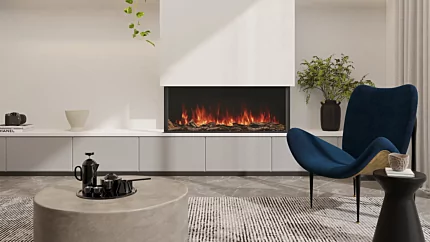
Electric fireplaces step around that problem. They create a flame field, an audio layer and a visual focal point without combustion or structural work, so they can live within standard lease conditions.

Published:
· Updated:

Why electric is the only fireplace category that works in a rental

Loading image...

thumbnail: webimage-ESF-EL40-Renovation-Aloha-HGTVEL40 Renovation AlohaHGTV

Bioethanol, gas, and wood-burning fireplaces are off the table in most apartments before the conversation even starts. They involve combustion, which means ventilation requirements, which means modifications to the building envelope a renter does not own. Gas needs a licensed installer and a line. Wood needs a flue. Even a free-standing bioethanol burner draws scrutiny because it consumes oxygen from the room.

Electric is different. Zero emissions, no flue, no chimney, no gas line, no combustion at all. The fireplace is an appliance, not a building modification, and at the plug-in end of the range it really is just furniture you bought. The broader case for electric fireplaces over combustion fires sits in our wider cluster, but for the rental conversation, electric is the only category that survives the lease.

The renter’s decision tree: which install pathway your lease allows

Renters have three install pathways for an electric fireplace: plug-in or freestanding, which needs no landlord approval and no wall work; wall-mounted with a bracket, which needs written landlord approval and stud access; and recessed or framed-in, which needs written approval plus a licensed electrician. The right pathway is determined entirely by your lease and your building’s electrical panel, not by the fireplace itself.

Pathway

Landlord approval

Wall work

Electrical

Suited EcoSmart model

Plug-in / freestanding

None

None

Standard 120 V outlet

Motion 30 (most compact) or Switch 44 freestanding

Wall-mounted with bracket

Written approval

Bracket into minimum two studs

Standard 120 V outlet

Motion 30 or Motion 52 (9.4 in depth)

Recessed / framed-in

Written approval and licensed electrician

Wall cavity construction

Dedicated 20 A circuit

Motion 52 recessed; larger Motion sizes if lease permits

The plug-in pathway is the renter’s structural default. You walk in with a fireplace, you walk out with the same fireplace, and the wall is exactly as you found it. The wall-mounted pathway opens up the cleaner architectural look, but it asks something of your landlord, and it asks the kind of thing landlords are most likely to grant: a small, reversible, documented modification.

The recessed pathway is for renters who have unusually cooperative landlords or who occupy a long-term lease that effectively functions as ownership. It needs a wall cavity, a dedicated circuit, and a tradesperson to sign off the wiring, all of which means the install lives on a different timeline to a Saturday afternoon.

One rule of thumb saves a lot of decision fatigue: if in doubt, default to plug-in. It is the only pathway that requires no one else’s permission.

Plug-in electric fireplaces: the zero-approval default

For most renters this is the answer, and treating it as a fallback option rather than the first-choice option misreads the rental reality. A plug-in freestanding electric fireplace is not a building modification. It does not require a landlord conversation, it does not require drilling, and it does not require an electrician. It is a piece of furniture that happens to throw an extraordinary flame.

The freestanding configuration in EcoSmart Fire’s electric range is genuinely freestanding. The same models that mount on a wall with a bracket can also sit against a wall on the floor — no bracket, no fixing, no anchor. Pick it up at the end of the lease, carry it to the next place, plug it back in. The Motion 30 is the lead recommendation here for the simple reason that it weighs about as much as a small piece of carry-on luggage, suits studios and one-bedrooms, and moves between rentals without ceremony. The Switch 44 sits in the same conversation when the room wants a slightly wider flame field.

At 1,500 W on a 120 V outlet, an electric fireplace draws 12.5 A. Never run it through an extension cord or power strip. This is a real electrical load, not a kettle on the kitchen bench, and it wants the wall socket directly. The same load explains why general electric fireplace safety practices point firmly at dedicated outlets rather than shared circuits when the heat function is in use.

The bond argument writes itself. Nothing on the wall means nothing to repair, nothing to photograph in the exit inspection, and nothing for the property manager to itemise.

Wall-mounting in a rental: how to ask, what to ask, what to fix later

Wall-mounting opens up the architectural look most renters were imagining when they started searching — the fire reading as part of the room, not a side table. It needs a bracket into a minimum of two wall studs, with anchors for the between-stud support; it never needs a third-party bracket; and it never needs the wall to be opened up. The bracket is the only wall modification. No recessing, no framing, no electrical rough-in.

The weight tells you what your wall needs to handle. The Motion 30 is around 51 lb [23.2 kg], the Motion 52 around 124 lb [56 kg], and the Switch 44 around 120 lb [54 kg]. None of these are extreme loads for a stud-anchored bracket, but they are all loads that want the bracket sitting on framing rather than on plasterboard alone. The Motion range’s 9.4 in [240 mm] depth makes it visually flatter against the wall than the deeper Switch, which is the most common reason renters land on Motion when wall-mounting is the plan.

At move-out, you are looking at four bracket holes. Bracket plugs, a touch of filler, a smear of paint matched to the wall colour, and the wall comes back to neutral in an afternoon. Not a tradesperson, not a quote, not a structural patch. The renter who photographs the wall on day one of the lease, in good light, makes the exit inspection straightforward.

What to put in the landlord-approval message

A landlord approval request for a wall-mounted electric fireplace should cover six points. Most landlords approve once they see the fireplace is plug-in, vent-free, and removable.

  1. Make, model, and dimensions of the fireplace (for example, EcoSmart Fire Motion 30, 30 × 23.9 × 9.4 in, 51 lb).

  2. Confirmation that the unit is electric, plug-in to a standard 120 V outlet, vent-free, and zero-clearance — no gas, no flue, no combustion of any kind.

  3. The mounting method: a manufacturer-supplied bracket fixed into two wall studs, with no recessing and no framing.

  4. Confirmation the unit is portable and will be removed at lease end.

  5. A commitment to repair the bracket holes to the landlord’s accepted standard before handover.

  6. An offer to share the manufacturer’s spec sheet on request.

That structure does most of the work because it answers the questions a landlord would otherwise have to ask. It also signals that you understand the building, which tends to move approvals along faster than the request itself.

Will your apartment’s electrical panel actually handle it?

Heat mode is what changes the conversation. In flame-only mode, an electric fireplace draws roughly the same power as a few LED bulbs — comparable to leaving a desk lamp on. Across the EcoSmart electric range, flame-only mode lands in the tens of watts, which is why renters who treat the fireplace as evening ambient light rather than a heater rarely notice the difference on the bill.

Maximum heat is the conversation that matters. At 1,500 W on a 120 V outlet, the draw is 12.5 A. On a healthy modern circuit that is unremarkable; on an older 15 A circuit shared with a kettle, microwave, or hair dryer, it is the kind of load that trips a breaker on a winter morning. The discipline is straightforward: avoid co-running high-draw appliances on the same circuit when the heat is on, and never bridge the connection with an extension cord or a power strip.

The 240 V option in the EcoSmart electric range unlocks the higher output operation that suits a larger room, but it lives on a dedicated 20 A circuit and needs a licensed electrician to wire it in. Older apartment buildings frequently lack a free dedicated breaker for this. Worth checking the panel before committing to a recessed install — the difference between a one-day install and a six-week negotiation with the building manager often turns on whether that breaker exists.

Small apartments and studios: the compact-placement playbook

Studios and one-bedrooms do not behave like the suburban living rooms most fireplace guides assume. Sightlines are short, walls are limited, and the room has to do several things at once. The placement question becomes part lighting design, part furniture geometry.

In a single open room, the fireplace earns its place on the wall opposite the bed. The sightline doubles as ambient evening lighting, and flame-only mode is genuinely low enough to leave running through a dinner or a film without thinking about the bill. The visual focal point pulls the room together in a way overhead lighting never quite manages.

For a one-bedroom living-dining shared wall, the wall the dining table faces tends to win. The Motion Picture Technology audio layer — the gentle wood-crackling soundtrack the range carries — does its best work in the open plan, because it threads under conversation without demanding attention. The room reads as evening, even when the kitchen lights are still on.

Bedrooms are the third scenario, where lease and building rules permit. The Switch 44 or Motion 30 with the timer set short turns the fireplace into a wind-down ritual rather than a heat source. EcoSmart’s Switch range is honestly framed as not intended to be a primary heat source, and in a small bedroom that framing reads as a feature: enough warmth to take the edge off, not so much that the room becomes uncomfortable by midnight.

A brief note for renters outside the US: strata, body-corporate, and EU rules

The renter experience varies enough across markets that the standard US framing only goes so far. A few regional notes for readers landing on this page from outside North America.

Australia. Plug-in is generally fine without committee approval — the unit reads as tenant furniture. Wall-mounting in a strata-titled apartment usually needs by-law clearance, so check before drilling. Note that EcoSmart Fire’s electric range is not sold through the Australian storefront; Australian readers source via the international site or work through the EcoSmart Australia channel for the bioethanol range.

United Kingdom. Most tenancy agreements require landlord consent for any wall fixing. Plug-in falls comfortably under tenant’s furniture, which is the same logic that lets you bring a lamp or a side table into the property. Anything that fixes into the wall is a different conversation, and getting it in writing is the discipline.

European Union. Tenancy rules vary widely by country and by tenancy type. The safe default for any wall work is written landlord approval before the bracket goes up. Plug-in remains the path of least resistance across the bloc.

Cost, running cost, and what you’re actually buying into

Premium electric is a fair framing for where the Motion and Switch ranges sit. These are the design-led models, the ones built for renters who refuse to compromise on aesthetics just because the lease is twelve months long. The entry-level flat LED panel competitors default to is a different product category; the comparison is closer to a designer pendant against a bare-bulb fitting than two versions of the same thing.

Running cost is where the numbers settle the question. On a Motion 52 in flame-only mode the draw is small enough to cost approximately two cents an hour at average US electricity rates — closer to leaving a few LED bulbs on than running an appliance. At maximum heat the same model lands at around twenty-four cents an hour. International readers can apply local kilowatt-hour pricing; the relationship between flame-only and full-heat running cost holds wherever you plug it in.

What you are actually buying into is the Motion Picture Technology aesthetic. Multi-dimensional flames that move like fire, a wood-crackling audio layer that threads through the room, and a flame field that reads as combustion at the depth a flat LED panel cannot reach. For a renter, that is the reason to spend at this tier: the fireplace has to earn its place in a room you do not own, and a flat panel does not do that work.

Loading image...

thumbnail: webimage-Switch-44BY-Electric-FireplaceSwitch 44BY - Residential Space CGI

The rental fireplace question, answered

The right fireplace for a renter is the one whose install pathway matches the lease. For most renters that pathway is plug-in, and the Motion 30 is the model that answers most rental briefs without further conversation — small enough to move between leases, light enough to install without help, and visually flat enough to read as architecture rather than appliance.

For renters with landlord cooperation and stud access, wall-mounting opens up the Motion 52 and the Switch 44, with the bracket as the only wall modification and four small holes to repair at move-out. For renters with full written approval and an electrician, recessing unlocks the rest of the range. At every pathway, the Motion and Switch ranges deliver the Motion Picture Technology aesthetic that motivated the search in the first place. The lease defines the install. The fireplace, in every version of this story, is still the fireplace.

Related Articles

Electric Fireplaces

Electric Fireplace Buying Guide: Everything You Need to Know

Buying Guides
Electric fireplace buying guide: technology, sizing, voltage, and install tips.

Electric Fireplaces vs Wood Fireplaces

Buying Guides
Compare the pros and cons of electric and wood fireplaces to determine the best option for your home.

Electric Fireplace Safety: Essential Tips for Homeowners

Safety
Essential safety guide for electric fireplaces: circuits, clearances, certifications.

Electric Fireplace Flame Technology Explained: LED, 3D, Holographic & Motion Picture

Technology
LED, holographic, water vapour & screen-based electric fireplace flame tech explained.

TV Above the Electric Fireplace: Design Strategies, Height & Heat Considerations

Others
Design strategies for mounting a TV above an electric fireplace safely.

Electric Fireplaces for Hotels & Commercial Spaces: Design, Safety & Compliance

Design Trends
Hotel electric fireplaces: design, safety, compliance, and cost overview.

Switch vs. Motion Electric Fireplaces: Which EcoSmart Fire Collection Is Right for You?

Buying Guides
Compare EcoSmart Fire Switch vs Motion on flame, environment and recess depth.

Electric Fireplace Accent Wall Ideas: Stone, Tile, Timber & Texture Combinations

Design Trends
Stone, tile, timber and plaster accent wall ideas for electric fireplaces.

How Long Do Electric Fireplaces Last? Lifespan, Durability & What to Expect

Buying Guides
How long electric fireplaces last, what wears out, and how to extend lifespan.