Blog

  /  

Switch vs. Motion Electric Fireplaces: Which EcoSmart Fire Collection Is Right for You?

Switch vs. Motion Electric Fireplaces: Which EcoSmart Fire Collection Is Right for You?

If you're weighing up the EcoSmart Fire Switch vs Motion electric fireplace decision, the easy answer is that both collections share the same heat output, the same cabinet construction, and the same dedicated 20-amp circuit requirement. The real choice lives somewhere else, in the flame technology you want to live with, the room you're putting it in, the depth of your recess, and how granular you want the control surface to be. The wrong assumption is that bigger is better, or that the more expensive collection is the more capable one. Neither is true, and letting that assumption shape a renovation costs you a build you can't easily reverse.

The Switch collection is outdoor-approved under permanent cover and uses Switch FX Technology to drive adjustable flame patterns and accent colours. The Motion collection is indoor only and uses Motion Picture Technology to render multi-dimensional, layered flames with a built-in wood-crackling audio track. Both sit at the premium end of our electric fireplaces collection, and the comparison below is what actually decides between them.

Author:
Rachel Glass
Published:
· Updated:

Loading image...

thumbnail: webimage-Switch-56RC-Electric-FireplaceSwitch 56RC - Residential Space CGI

Switch vs Motion at a glance

Attribute

Switch

Motion

Flame technology

Switch FX Technology

Motion Picture Technology

Environment

Indoor and outdoor under permanent cover

Indoor only

Smallest size

Switch 44 (1,118 mm [44 in] wide)

Motion 30 (762 mm [30 in] wide)

Largest size

Switch 120 (3,048 mm [120 in] wide)

Motion 120 (3,159 mm [124 in] wide)

Depth

293 mm [11.5 in]

243 mm [9.6 in]

Heat modes

No Heat / Low / High

H0 / Fan only / Low / High

Controls

RF remote with preset zones

Touch panel, master power switch and remote with independent element control

Smart home

Alexa and Google Home

Not confirmed

Wood-crackling audio

Not documented

Yes, dedicated audio control

Price tier

Lower entry point

Premium tier

Flame technology: Switch FX vs Motion Picture

The two collections do not draw their flames the same way, and the difference is the clearest functional gap between them. Switch FX gives you a programmable look, an LED zone array that you adjust by remote until the flame and accent colours match the mood you want. Motion Picture builds a multi-dimensional flame on a different optical assembly entirely, layering a moving flame over an independently controllable ember bed and downlight, then adding a wood-crackling audio track underneath. One is dialled-in mood. The other is closer to cinematic immersion.

The crackling matters more than most people expect. In an open-plan room with no chimney throat to soften the acoustic, a silent flame can read as decorative wallpaper, beautiful but inert. A fire that crackles is recognisably a fire. According to a University of Alabama study by Dr Christopher Lynn, published in Evolutionary Psychology in 2014, watching a fire with sound produced a significant drop in blood pressure and a measurable rise in relaxation, while the same fire watched in silence had little to no effect. The sound is the variable doing the work.

How Switch FX Technology works

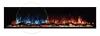
Switch FX is EcoSmart Fire's adjustable-pattern LED flame technology, a set of programmable flame styles and accent-colour presets controlled by RF remote. The flame zone, ember bed and downlight all run through the same colour wheel, so you can shift the whole composition in a single action. The remote ships with eight preset colour scenes that cycle through warm orange, red-orange, golden, green, aqua, blue and magenta tones, plus seven demo modes for gradient and fade behaviour. There is no audio feature. Switch ships with a curated Canyon Driftwood log set and clear and smoke acrylic stones, which is the only media kit you'll need for the unit.

How Motion Picture Technology works

Motion Picture is EcoSmart Fire's multi-dimensional flame technology, layered moving flames running over an independently controlled ember bed, an independent downlight, and a built-in wood-crackling audio track. Three distinct flame styles cover a wood-fire reading, a gas-fire reading and a hybrid look, with six colour presets per style and a flame-speed control on top. The ember bed runs through ten colours plus a fade, with five brightness levels of its own. The downlight runs through its own ten colours plus a fade. Audio sits on a dedicated button with volume steps. Motion ships with two media kits in one unit, Western Driftwood Logs for a naturalistic read and Black Crushed Glass for a contemporary one.

Loading image...

thumbnail: webimage-Motion-76RC-Electric-FireplaceMotion 76RC - Residential Space CGI

Where can you install each? Indoor-only vs outdoor-approved

EcoSmart Fire's Switch electric fireplaces are approved for indoor and outdoor installation under permanent overhead cover. Motion electric fireplaces are indoor only.

That sentence is the single biggest decision lever in this comparison, and it's worth unpacking what "under permanent cover" means in practice, because the term has been misread enough times to cause real install regret. Cover does not mean a retractable awning. It does not mean a tree, a market umbrella or a pergola with a louvred roof open to the sky. It means a permanent, roofed structure that keeps the unit out of direct rain, off-axis spray, and direct sunlight on the glass.

Both collections share the same electrical baseline, a dedicated 20-amp circuit running to a two-pole breaker for the full 10,000 BTU/hr (2.9 kW) heat output. The Switch outdoor approval is layered on top of that baseline as a designed feature, not a relaxed allowance. Outdoor installations that don't meet the spec void the warranty, which is the brand's way of saying the approval is earned by the install, not by the product alone. For readers exploring outdoor electric fireplaces, the Switch is the only choice in the range.

Switch indoor and outdoor under cover

The Switch series has been tested and approved for installation outdoors under a patio cover, away from direct water contact and away from direct sunlight on the glass. The standard warranty applies in full provided you install to the outdoor spec. Two geometry rules matter. First, the patio roof overhang at the front of the fireplace has to be at least 50% of the height H from the base of the fireplace, so a 1.8 m mounting height needs at least 900 mm of overhang in front. Second, the side distance has to be at least 50% of that same height H, which protects against wind-driven rain. There is also a 51 mm [2 in] minimum floor clearance under the base. The Switch sits comfortably in covered patios, alfresco rooms, garden rooms and roofed loggias where the build provides those clearances, which is most of the category once you measure for it.

Motion indoor only

Motion is explicitly designated indoor only. The optical assembly that produces the multi-dimensional flame, the integrated audio module and the layered LED array sit behind the toughened glass front in a configuration tuned for an interior environment, and the safety documentation reads "Do not use outdoors" without qualification. What that designation unlocks is a much wider design vocabulary on the inside.

Indoor-only means the unit is engineered for the wall recess, the media frame, the bedroom feature wall, the hospitality lobby, the apartment fitout, the bedside-of-the-bath room where moisture is controlled but presence is not. For specifiers, that's a different brief from the Switch. It's worth saying the two collections are not a single product in two trims, they're two products with different installation domains.

Dimensions, sizing and recess depth

Switch electric fireplaces sit at approximately 293 mm [11.5 in] deep across every size. Motion electric fireplaces sit at approximately 243 mm [9.6 in] deep across every size. That 50 mm gap, just under two inches, is small on paper and decisive in a wall recess. It is, more often than not, the difference between a build that lands flush against the back of a stud wall and one that requires a steel-beam furr-out, a header notch, or a service relocation in a remodel.

Size

Width

Switch

Motion

30

762 mm [30 in]

No

Yes

44

1,118 mm [44 in]

Yes

No

52

1,308 mm [51.5 in]

No

Yes

56

1,422 mm [56 in]

Yes

No

60

1,524 mm [60 in]

No

Yes

68

1,727 mm [68 in]

Yes

No

76

1,924 mm [75.75 in]

No

Yes

80

2,032 mm [80 in]

Yes

No

96

2,438 mm [96 in]

Yes

No

100

2,540 mm [100 in]

No

Yes

120

3,048 mm [120 in]

Yes

No

120

3,159 mm [124.4 in]

No

Yes

How to read the table.

The depth column doesn't change as you scale up or down, both collections hold a single depth profile across all six sizes. Height is similar, with Switch at 632 mm [24.9 in] and Motion at 617 mm [24.3 in]. The size lever is therefore width, and the two ranges interleave rather than overlap. There is no 30-inch Switch, which makes the Motion 30 the only sub-44-inch option in either collection, and it's the right answer for compact rooms, bedroom feature walls and powder rooms where a 1,118 mm Switch would dominate.

At the top end, both ranges reach 120-inch territory for commercial lobbies, double-height living rooms, and hospitality interiors, with the Motion 120 measuring slightly wider than the Switch 120. If you're sketching a modern electric fireplace recess, measure the wall cavity before you fall in love with a particular collection.

Controls and smart-home integration

Switch is preset-driven. Motion is composition-driven. Both are premium control surfaces, but the philosophies behind them are not the same, and the right one depends on whether you want speed or granularity in the moment.

Switch runs through a touch panel on the upper right of the unit and an RF remote with eight all-zones colour presets plus seven demo modes, which lets you change the whole flame composition in a single press. Motion runs through a touch panel plus a master power switch plus a remote that addresses every element separately, the flame style, the colour preset within the style, the speed of the flame, the ember bed colour and brightness, the downlight colour, and the audio volume. There is one functional nuance worth flagging because it catches buyers out. On the Switch, the heater operates independently of the flame, so you can run flame only or heat only. On the Motion, the heater only operates when the flame is on, so heat-without-flame is not available. Flame-without-heat works on both, which is the mode most buyers want in shoulder seasons.

Switch zone presets and voice control

The Switch RF remote is the simplest path to a complete mood change. One button shifts every zone, the flame, the ember bed and the downlight, to a co-ordinated colour scene, and the eight presets cover most decorating registers without going through a sub-menu. Voice integration matters here too. Alexa and Google Home integration is confirmed for the Switch range, so the same scene change can run on a voice command from across the room, which is the natural pairing for the preset model. Quick, intuitive, and the right tool for an owner who wants the flame to look the way they want it to look without thinking about it.

Motion independent element composition

The Motion remote does something the Switch remote can't. It addresses each element of the visual independently, so you can run a slow wood-style flame against a deep red ember bed under a cool white downlight with the audio dialled down low, then save that scene in your head and recompose it next week. For anyone building a precise room atmosphere, that granularity is the point. The trade-off is that voice-assistant integration is not currently confirmed at the product level, and the master power switch above the touch panel adds one extra action to the on-off routine. There's also a 20 to 30 second boot time after a full power reset, which is documented in the brand's operation article and worth knowing before you call a service tech.

Heat modes, heating performance and operating cost

Both Switch and Motion produce 5,000 BTU/hr (1.5 kW) on 120V wiring and 10,000 BTU/hr (2.9 kW) on 240V wiring, with coverage of up to 56 m² [600 ft²]. The output is identical. The mode granularity isn't. Switch offers No Heat, Low Heat and High Heat, with a footnote that on 120V wiring Low and High produce the same output, so the full 10,000 BTU/hr (2.9 kW) requires the 240V install. Motion runs H0 (off), F (fan only with no heat), H1 (low heat) and H2 (high heat), and the fan-only mode is genuinely useful in shoulder-season rooms where you want air movement without warming. The heater dependency rule comes back here too. Motion's heater needs the flame to be on, so flame-only is fine but heat-only is not a configuration.

LED draw runs at around 42 to 106 W on the Switch and 30 to 85 W on the Motion, depending on model size, so flame-only running costs negligibly little, comparable to leaving a couple of pendant lights on. Both collections are designated supplemental heat sources in the safety documentation, not whole-home heating, which is consistent with the published industry view that energy-efficient electric fireplaces convert close to 100% of input electricity to heat in the occupied room, with no flue loss. For a broader primer on coverage maths and BTU planning, our electric fireplaces range covers a full size ladder for both collections. Treat the operating cost as inexpensive flame-only and modest on full heat, broadly comparable to a small space heater, and don't try to pin it to a number that won't survive a tariff change.

Aesthetics, included media and design fit

Both collections share the same architectural shell, a black powder-coated mild steel cabinet behind a toughened glass front, in four configurations (single-sided, left corner, right corner, bay). The structural language is consistent, which is part of why these read as a coherent range across both technologies. Where they diverge is in the media kit and what that media implies about the room around it.

Switch ships with Canyon Driftwood Logs and decorative clear and smoke acrylic stones, one curated set tuned to the adjustable accent colours. A coastal sitting room, a stone hearth, a brushed-timber media wall, the driftwood reads as the right material with the right grain. Motion ships with both Western Driftwood Logs and Black Crushed Glass, two media options inside the same unit, which is unusual at this tier. The driftwood reads naturalistic in a Hamptons living room or a country house lounge. The crushed glass reads architectural in a city apartment, a hotel lobby, a basement bar. Same fireplace, two distinct visual registers, which buys real design flexibility for an interior that may evolve in styling over its life. The toughened glass front is consistent across both collections, the cabinetry finish is consistent across both collections, and the construction tier reads as deliberate rather than parts-bin.

Price tier and value framing

Switch is the lower entry point in the premium electric fireplaces range. What that entry buys is outdoor approval under permanent cover, voice-assistant integration through Alexa and Google Home, a preset-driven control surface that's quick to learn, and the same shell construction as the rest of the range. For most buyers whose install lives under cover or indoors and who want a refined but uncomplicated control story, the Switch is the natural choice and the value is obvious in the spec sheet.

Motion sits at the premium end of the range because the multi-dimensional flame, the integrated audio, the independent-element controls and the dual media kits add to the optical and electronic assembly inside the cabinet. The Motion 30, our smallest electric fireplace, is the only sub-44-inch option in either collection, and the price tier reflects the engineering rather than a styling tax. Buyers who specify Motion are usually paying for the depth of the visual, the crackling audio, and the granularity of the control surface. None of that is unavailable on the Switch by accident, it's a different product with a different ambition.

Which EcoSmart Fire collection is right for you?

Choose Switch for outdoor-approved installations under cover and preset-based control. Choose Motion for indoor-only installs with multi-dimensional flame, crackling audio and independent element control.

Choose Switch if you need outdoor approval under permanent cover, you want quick preset mood changes through a single remote action, voice-assistant integration matters to your home setup, your wall recess can carry roughly 293 mm [11.5 in] of depth, and the lower entry point in the range is part of the brief. The Switch is also the natural answer for covered alfresco rooms, deep garden-room verandas and loggia builds where the unit needs to live with the seasons.

Choose Motion if the install is strictly indoor, you want the most immersive flame with the wood-crackling audio under it, you need granular composition of flame style, ember bed, downlight and audio in the same scene, you're working to a shallower recess of roughly 243 mm [9.6 in], or you need a unit narrower than 44 inches and the Motion 30 is the only sub-44-inch option in either collection.

Choose either if heat output, coverage and core shell construction are your only criteria. Both produce the same 5,000 BTU/hr (1.5 kW) and 10,000 BTU/hr (2.9 kW) outputs on 120V and 240V respectively, both cover up to 56 m² [600 ft²], and both share the same cabinet language. When those are the only filters in play, defer the decision to flame technology, environment and control philosophy. They're the variables that will actually shape how the room feels once the build is done.

Loading image...

thumbnail: webimage-Switch-Electric-SeriesSwitch Electric Series
Switch Electric Series

Closing the choice

Match the collection to the space, not the space to the collection. Once heat output, coverage and the dedicated 20-amp circuit are off the table as differentiators (they're identical on both), the decision narrows cleanly to flame, environment and control. Switch for the outdoor-under-cover install, the preset-driven owner, and the voice-assistant household. Motion for the indoor install, the granular composer, the audio-on-with-the-flame brief.

Both sit inside our broader collection of electric fireplaces, and both have a six-strong size ladder that interleaves the other. Walk the size range, measure the recess, and pick the technology that matches the room you're building for. That order, in that sequence, is how this decision lands cleanly.

Frequently asked questions

Can the Switch electric fireplace be installed outdoors with no cover?

No. The Switch is tested and approved for installation under a permanent overhead cover only. The patio roof overhang at the front of the unit must be at least 50% of the height H from the base of the fireplace, and the side distance must meet the same 50%-of-H rule. Direct rain exposure, direct sunlight on the glass and unprotected siting all sit outside the outdoor spec and void the warranty.

Does the Motion electric fireplace work with Alexa or Google Home?

Voice-assistant integration is not currently confirmed for the Motion at the product level. Alexa and Google Home integration is confirmed for the Switch range. Both collections are controlled by their touch panel and remote as the primary interface, and a master power switch on the Motion adds a physical on-off step above the touch panel.

Can either collection run flame-only with no heat?

Yes, both can run flame only. The Switch's heater operates independently of the flame, so flame-only, heat-only or both at once are all valid configurations. On the Motion the heater only operates when the flame is on, so heat-without-flame is not a configuration, but flame-without-heat works the same as the Switch and is the mode most owners use in shoulder seasons.

What's the shallowest EcoSmart Fire electric fireplace?

The Motion, at approximately 243 mm [9.6 in] across every size in the collection. That's around 50 mm shallower than the Switch's 293 mm [11.5 in] depth, and the gap is decisive in tight wall recesses, party-wall builds and remodels where the structure behind the fireplace can't easily move.
References

Related Articles

Electric Fireplaces

Electric Fireplace Buying Guide: Everything You Need to Know

Buying Guides
Electric fireplace buying guide: technology, sizing, voltage, and install tips.

Electric Fireplaces vs Wood Fireplaces

Buying Guides
Compare the pros and cons of electric and wood fireplaces to determine the best option for your home.

Electric Fireplace Safety: Essential Tips for Homeowners

Safety
Essential safety guide for electric fireplaces: circuits, clearances, certifications.

Electric Fireplaces for Apartments & Renters: No-Permit, No-Damage Solutions

Buying Guides
Install guide for renters: plug-in, wall-mount, or recessed electric fireplaces.

Electric Fireplace Flame Technology Explained: LED, 3D, Holographic & Motion Picture

Technology
LED, holographic, water vapour & screen-based electric fireplace flame tech explained.

TV Above the Electric Fireplace: Design Strategies, Height & Heat Considerations

Others
Design strategies for mounting a TV above an electric fireplace safely.

Electric Fireplaces for Hotels & Commercial Spaces: Design, Safety & Compliance

Design Trends
Hotel electric fireplaces: design, safety, compliance, and cost overview.

Electric Fireplace Accent Wall Ideas: Stone, Tile, Timber & Texture Combinations

Design Trends
Stone, tile, timber and plaster accent wall ideas for electric fireplaces.

How Long Do Electric Fireplaces Last? Lifespan, Durability & What to Expect

Buying Guides
How long electric fireplaces last, what wears out, and how to extend lifespan.