Upfront cost: what you pay before installation even starts
Loading image...
Across the four technologies, upfront unit cost runs from entry-level (electric portables) at the bottom to premium-tier wood-burning at the top, with gas and bioethanol sitting between them in the mid-to-premium band. That spread is wider than most buyers expect, and the drivers are not what showroom signage usually highlights.
Wood-burning units carry the heaviest unit cost not because the appliance itself is expensive in isolation, but because the unit and its required structure travel together. A zero-clearance wood firebox is itself only a portion of the install, with Class A chimney, masonry, and hearth materials sitting alongside it. The unit price you see quoted often understates what you are actually buying. Gas inserts sit a tier lower, with a typical fireplace insert package quoted in the mid range. Electric inserts span the widest band of any single category, from entry-level portable models to premium architectural inserts with linear glass and high-fidelity flame technology.
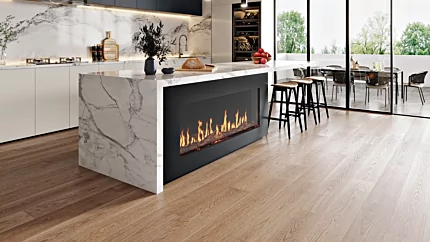
Bioethanol is the category most buyers have never priced. The premium tier sits at the architectural end with multi-burner, recessed installations, but the entry point for a freestanding or insert-style bioethanol fire is closer to the mid-range gas band, with no infrastructure attached. EcoSmart Fire introduced the architectural bioethanol fireplace category and remains the benchmark against which other formats are measured, which is why the Flex and Frame ranges are specified for commercial and high-end residential installations worldwide. That difference matters more in the next section than this one.
EcoSmart Fire's electric range fits this story cleanly. The Switch series, an architectural electric range with six sizes spanning 44 in to 120 in (available in the US and Canada), sits in the premium tier on unit cost, justified by the linear footprint and the flame realism that defines the category. The Motion series, also six sizes from 30 in to 120 in (US and Canada), occupies the same premium architectural band with its proprietary Motion Picture Technology flame display. On the bioethanol side, our Flex and Frame ranges sit in the same architectural specification conversation, with heat output reaching the high end of the bioethanol range for fully open-flame installations. For specifiers, the value is not the unit price itself but what the tier buys: a fire that reads as a permanent piece of the room's architecture, not a portable appliance.
One context note before the table. Specific dollar figures in this category are notoriously regional. The same fireplace insert costs differently in Sydney, London, Los Angeles, and Berlin. The tiers below hold; the precise numbers shift with each market.
Technology | Tier position | Heat range | Key cost driver |
|---|---|---|---|
Electric inserts | Entry-level to premium | 5,000 to 10,000 BTU/hr (1.5 to 3 kW) | Display technology, glass scale, linear length |
Gas inserts | Mid to premium | 20,000 to 40,000+ BTU/hr (5.9 to 11.7+ kW) | Burner specification, log set, glass enclosure |
Wood-burning | Premium | 30,000 to 80,000+ BTU/hr (8.8 to 23.4+ kW) | Firebox material, masonry, chimney system |
Bioethanol | Mid to luxury | Up to 13 kW (44,350 BTU/hr) | Burner length, glass, architectural finish |
The takeaway from the upfront column is narrower than it looks. Yes, electric inserts can start at the lowest entry point of the four. But buyers shopping at the architectural end of the market will find electric, gas, and bioethanol clustered closer than they expect. The real separation happens at install.