Loading image...


The flame is the first thing the eye lands on, and it's the only thing the eye trusts. A convincing electric flame doesn't ask you to suspend disbelief; it asks you to look closer. Most of what's marketed as "realistic" still gives the trick away within seconds. The motion is too uniform, the light too flat, the bed of glowing media too obviously decorative rather than alive. Where the illusion fails, it tends to fail in the same place: a single optical plane, viewed from one correct angle, doing all of the work alone.
EcoSmart Fire's Motion range takes a different approach to the same problem. Instead of treating the flame as an image to project, it treats the flame as a scene to construct, built from three physical layers stacked between the LEDs and the viewer. The result is a flame that holds up at oblique angles, reads with depth, and stays convincing when the room is quiet and someone is sitting close enough to study it.
Loading image...
A motion picture electric fireplace is one that uses EcoSmart Fire's proprietary optical system, in which low-wattage LEDs, physical decorative media, and a toughened glass screen work together to produce multi-dimensional flames visible from every angle. The technology updates the flame image thirty times per second, which is closer to the refresh rate of broadcast video than to the on-off cycling of a standard LED light.
That matters because the realism problem in electric flames is not a brightness problem. It's a depth problem. The standard approach in the category, an LED array behind a spinning refractor disc, produces light patterns that look correct only from directly in front of the unit. Step a metre to the side and the illusion collapses into a moving silhouette.
Motion Picture Technology sits across the EcoSmart Fire Motion range, from the compact portrait inserts through to the architectural-scale landscape units. The mechanism is the same across the range; what changes is the canvas size and the installation format.
Loading image...
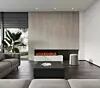

The flame the viewer sees is the product of three physical layers, arranged front to back: an LED projection layer at the rear, a bed of decorative media in the middle, and a toughened glass plane at the front. Each layer does one job. Together they produce something a single-plane LED display cannot.
Layer one is the engine. A low-wattage LED array projects the animated flame pattern upward through the unit, driving the colour, the shape, and the motion that the rest of the system will modify. This is display wattage, not heat output, which means flame-only mode draws a small fraction of the unit's full electrical load. EcoSmart Fire's support documentation also describes the rendering element as an LCD-driven panel, suggesting the LED light passes through a diffusion layer before it reaches the media, which is consistent with the smoothness of the resulting motion.
Layer two is the layer competitors quietly skip. The decorative media, whether the driftwood log set or the black crushed glass bed, sits directly in the projection path and physically refracts and scatters the light moving through it. Logs catch the projected flame across their carved contours, breaking the pattern into the wrapping, irregular shapes that real flames make around real fuel. Crushed glass takes the same light and scatters it into hundreds of ember-like points that flicker as the projection underneath changes. The media is not a finishing touch sitting on top of the optics. It is part of the optics.
This is why the choice between logs and crushed glass changes the character of the flame, not just the look of the bed. Two units, identical apart from their media, will produce visibly different flame shapes for the same reason two real fires built with different fuel produce different shapes.
Layer three is the toughened glass fire screen, set forward of the media on its own plane. The screen does two jobs. It catches a faint reflection of the flame from the layer behind it, giving the eye a second optical reference point at a slightly different depth. As the viewer moves, the relationship between the media and the glass shifts, and the brain reads that shift as parallax. That parallax is what registers as depth. It is also the safety screen the customer touches, cool to the hand, with no direct contact between the viewer and any heated element.
Loading image...
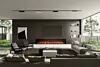
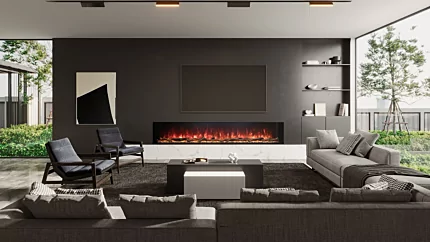
The three-layer system reads as more convincing because it satisfies more of the cues the brain uses to identify a real fire. A spinning-refractor unit gives the eye one cue: pattern movement at a fixed depth. Layered optics give the eye three: pattern movement, parallax between the media and the glass, and light refraction off a physical surface that changes the projected shape in real time. None of these cues is decisive on its own. Together they push the image past the threshold where the brain starts asking questions.
Motion parallax is doing more work in this than the spec sheet credits. The optical change of the visual field that results from a change of viewing position, as the perceptual psychologist James J. Gibson defined it, is one of the strongest depth cues the human visual system has, and it works even with one eye closed. A single-plane LED display cannot trigger it; a layered optical system does so by default, every time the viewer moves their head.
Then there is the part of the realism story that has nothing to do with optics. The crackling audio layer is engineered as a realism component, not a feature. A silent fire reads as a screensaver; an audible one reads as an event. The audio sits on its own control so the visual ambience can run without it during conversation, then come back when the room settles.
Realism dimension | Standard LED refractor | Motion Picture Technology |
|---|---|---|
Flame motion | Repeating refractor pattern | Three flame styles, six colours each, three speeds |
Viewing angle | Reads correct from front only | Holds up at oblique angles |
Ember bed | Painted or static media | Independent LED bed, ten colours, fade mode |
Audio | None or generic loop | Engineered crackling layer, independently controlled |
Customisation | Limited flame and brightness | Independent flame, ember, downlight, and audio control |
The configurability-first counterpoint inside EcoSmart Fire's own catalogue is the Switch FX range, which uses high-definition LED simulation without the physical media layer. The split tells you where the brand has placed each technology. Switch FX optimises for recessed, lower-profile installations where the viewing angle is more controlled. Motion Picture is reserved for the cases where the flame is the point of the room.
Water vapour deserves credit. As an electric category, it produces the most volumetric flame in the market, because the "flame" is literally a column of mist being lit, not an image of a flame at all. The trade-off is that it requires a water reservoir, regular refilling, and ambient humidity output that a homeowner has to be comfortable with in the room. Where humidity is unwelcome, where the unit is going into a space without easy refill access, or where the installation needs to disappear into a wall, the trade-off lands the wrong way.
Motion Picture sits in the slot between the two: more depth than a standard LED unit, less moisture and maintenance overhead than water vapour. For a broader product comparison across the line, the full electric fireplaces range covers each model.
Technology | Mechanism | Realism strength | Trade-off | Best for |
|---|---|---|---|---|
Standard LED with refractor | LED array behind a rotating disc | Pattern motion only | Reads correct from one angle | Budget inserts, secondary rooms |
Water vapour | Ultrasonic mist lit from below | Strong volumetric flame | Water reservoir, humidity output, regular refilling | Spaces where humidity is acceptable |
Motion Picture | Three-layer optical system (LED, media, glass) | Multi-angle depth, parallax, audio | Requires a dedicated circuit | Primary living spaces, specified projects |
Loading image...
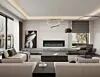
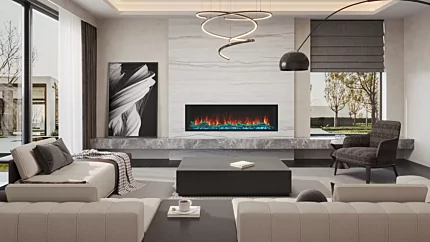
For a residential setting, the interesting feature isn't the wattage. It's the separation between flame and heat. The flame runs without the heating element, which means the ambience is available year-round, including the months where the last thing a room needs is another heat source. The control granularity, independent flame colour, ember-bed colour, downlight, and audio level, gives the room more than one mood without changing anything else about the install.
For projects that require dimensional and electrical predictability, the range is built for it. Three installation formats from a single unit, wall-mounted, partial recess, or fully built-in, mean the same model adapts to multiple architectural conditions. The clearance from combustibles is 0.9 m (3 ft). Specifying a flue-vented fireplace forfeits the ability to place a flame on a wall that has no roofline above it, and that constraint disappears here. Dual-voltage 110–240 V operation on a dedicated 20 A circuit makes the range usable on international projects where the electrical environment changes from one site to the next.
Yes. The flame, ember bed, and downlight run independently of the heating element, which is the configuration most owners use through warmer months. Heat is a separate switch on the touch panel and on the remote.
The unit runs a brief boot sequence on power-up, in which the controller initialises the LED rendering, the audio module, and the user-set scene from its last state. It's the same reason a television takes a few seconds to come on. Once running, the flame responds to control changes immediately.
Yes. Three distinct flame styles, six colour presets per style, and three speed settings cover most rooms. The ember bed and the downlight are tuned separately, with ten colours each and a fade mode that cycles slowly through them. Most owners settle into one configuration for everyday use and shift it for occasions.
The range needs a dedicated 20 A circuit. On 120 V supply the wiring is three-wire; on 240 V supply it's four-wire on a two-pole breaker. The unit ships with full installation documentation, and the electrical work should sit with a licensed electrician. Full safety credentials for the range include UL and ETL certification in North America and CE marking in Europe.
Loading image...
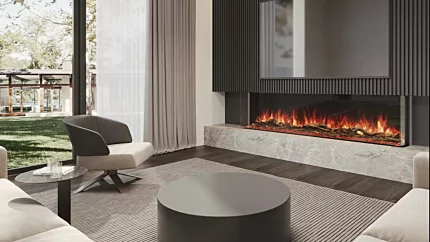
What the eye reads as a real flame isn't one feature doing the heavy lifting. It's LEDs, media, glass, and audio working in correlation, with each layer contributing the part of the illusion the next layer can't. Strip out the media and the flame flattens; strip out the glass and the depth disappears; strip out the audio and the room goes quiet in a way real fires never do. The realism lives in the relationship between the layers, not in any one of them.
That's the part the category usually leaves out. A flame that holds up at the angle you actually look at it from, in the room you actually live in, is a system. The Motion range is built around that fact, and once you've seen it work, the older approach starts looking like a single trick repeating itself.