
Blog

  /  

Energy Efficiency Guide for Electric Fireplace Inserts

Energy Efficiency Guide for Electric Fireplace Inserts

A traditional masonry fireplace can lose 70 to 90 percent of the heat it generates straight up the flue, which is a remarkable thing to learn about an appliance whose entire job is to keep you warm. Electric fireplace inserts skip that loss entirely. There is no flue, no combustion stage, no draught pulling warm air out of the room. Every watt the unit draws becomes either light or heat, and almost all of it stays where you put it.

That single design difference is why efficiency has quietly become the headline reason homeowners now choose electric over gas, wood, or even high-end bioethanol for everyday use. The other reasons (clean install, no servicing schedule, the freedom to place a fire on any wall in the house) follow from the same physics.

This guide walks through what energy efficient electric fireplace inserts actually deliver, with verified per-model running cost figures, LED wattage data, dual-voltage heating coverage, and the operating habits that turn a good appliance into a low-bill one. It is written for homeowners making a purchase decision and for specifiers who need defensible numbers to put in front of a client.

Author:
Rachel Glass
Published:
· Updated:

Loading image...

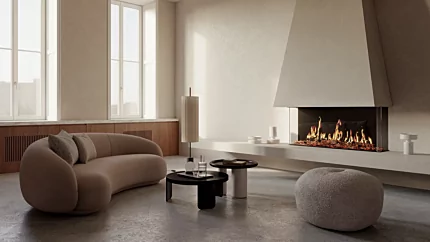
thumbnail: webimage-Motion-60BY-Electric-FireplaceMotion 60BY - Residential Space CGI

How electric fireplace inserts achieve 100 percent point-of-use efficiency

Electric fireplace inserts convert 100 percent of the electricity they draw into heat or light inside the room, because there is no flue, vent, or combustion stage to lose energy through. The U.S. Department of Energy puts it plainly: electric resistance heating is fully efficient at the point of use, with all incoming electrical energy converted to heat.

Three mechanisms make this work in our electric fireplaces range:

  • Resistive heating. When current passes through the heating element, the resistance turns the electrical energy into heat. There is no flame producing carbon monoxide, no draft to feed combustion, no escape route for warm air.

  • No flue, no loss path. A traditional fireplace needs a chimney to vent combustion gases, and the chimney also vents heat. Electric inserts have no such opening.

  • LED light generation. The flame visual is produced by LED arrays drawing tens of watts, not by an incandescent bulb pulling hundreds. Most of the energy used for ambience becomes visible light rather than waste heat.

A small caveat keeps the picture honest. Point-of-use efficiency is not the same as source-to-socket efficiency. If your electricity is generated by a distant gas turbine, transmission and generation losses sit upstream of your meter. The numbers in this guide describe what happens once power arrives at the appliance, which is the part the homeowner pays for and controls.

What it actually costs to run an electric fireplace insert per hour

An EcoSmart Fire electric fireplace insert costs roughly 2 cents per hour to run in flame-only mode and around 24 cents per hour with the 1,500W heater active, using an example electricity rate of 16 cents per kWh. The U.S. Energy Information Administration’s February 2026 monthly update has the national residential average closer to 17.65 cents per kWh, which would push the heater-on figure to about 26.5 cents per hour.

The arithmetic is the same wherever you live. Hourly cost equals wattage divided by 1,000, multiplied by your local rate per kWh. Run it on your own utility bill and the number is exact.

Operating mode

Wattage

Hourly cost at 16¢/kWh

Flame-only (ambience)

~30 to 106W depending on model

~0.5 to 1.7¢

Heater on, 120V

1,500W

~24¢

Heater on, 240V

3,000W

~48¢

Two things to note about that table. First, the flame-only mode is genuinely cheap to run. Leaving the visual on for a full evening costs less than the lamp on the side table. Second, the Switch FX series at 120V draws the same wattage on Low and High heat settings: the lever that changes running cost is not the heat dial, it is whether the heater is on at all. If you want the flame for atmosphere and don’t need the warmth, switching off the heating element saves more than you can save by adjusting a thermostat.

For a sense of monthly impact, four hours of flame-only viewing every evening for thirty days lands inside a typical takeaway-coffee budget. Four hours of heated viewing on the same schedule is a more meaningful number, but it is replacing the equivalent runtime on your central heating, not adding to it, and that is the point of the next section.

BTU output, heating area, and the dual-voltage efficiency lift

The dual-voltage story is one of the most underrated specifications in the category. The same insert, wired into a 240V circuit instead of a 120V outlet, doubles its heating capacity. No mechanical change, no second appliance.

Voltage

Wattage

BTU/hr

kW

Heating area

120V

1,500W

5,000 BTU/hr

1.5 kW

300 ft² (28 m²)

240V

3,000W

10,000 BTU/hr

3.0 kW

601 ft² (56 m²)

A 120V setup is the right answer for a bedroom, study, or a den that gets used in the evenings. A 601 ft² (56 m²) heating area on 240V opens up open-plan living rooms and larger lounges. If you are specifying a fireplace for a great room and the electrician has already run a 240V circuit for the kitchen or the laundry, the higher-voltage option is usually the easier sell.

A useful caveat sits behind the spec sheet. The heater stage produces the same output across every width in the range, so a wider unit does not heat more of the room. The width decision is about visual presence and how the unit fits the wall, not about how much warmth it pushes out. That is a subtle thing the showroom will not necessarily volunteer, and it is worth holding in mind when you are picking between a 60-inch and a 100-inch model. The wider one looks more dramatic; both warm the same square footage.

Electric inserts are designed as supplemental heat. They are excellent at lifting the temperature of an occupied room by several degrees and holding it there, which is exactly what zone heating asks them to do. They are not designed to replace a primary central heating system for a whole house in mid-winter.

Zone heating: the efficiency strategy electric inserts unlock

Zone heating means heating only the room you are occupying, instead of running central heating across the whole house, and electric fireplace inserts are purpose-built for this efficiency strategy. The U.S. Department of Energy notes that zone heating can produce energy savings of more than 20 percent compared with heating the whole area of your house.

The mechanics are intuitive. Drop the central thermostat two or three degrees and let the insert lift the room you are actually using back up to comfort. The DOE estimates households can save up to 10 percent a year on heating and cooling by turning the thermostat back 7 to 10 degrees Fahrenheit for eight hours a day, and zone heating gives you a comfortable way to do that without sitting in a cold living room.

Zone heating works well when:

  • You spend most of your evening in one or two rooms (lounge, kitchen, primary bedroom)

  • The room you are heating is well sealed and reasonably insulated

  • Your central heating bill is a meaningful share of monthly outgoings

  • The rest of the house can be allowed to drift cooler overnight

It works less well in homes with poor insulation, draughty single-glazed rooms, or open-plan layouts where the “zone” is most of the ground floor anyway. In those cases the insert will still do useful work, but the savings story is more modest.

The practical habit to pair with zone heating is the built-in timer. Setting a half-hour run window on the Motion Picture Flame range removes the question of whether you remembered to switch the heater off when you went to bed. The fire warms the room while you wind down, then quietly turns itself off. The most efficient hour of fireplace use, in many homes, is the hour you didn’t notice the heating was on.

Loading image...

thumbnail: webimage-Motion-76RC-Electric-FireplaceMotion 76RC - Residential Space CGI

LED flame technology and why it costs almost nothing to run

The LED flame system in an EcoSmart Fire electric insert draws between 30 and 106 watts depending on width, which is less than a standard household incandescent bulb, and the LEDs are rated for tens of thousands of hours before they reach the 70 percent lumen maintenance threshold the lighting industry uses as end-of-life.

Model

LED wattage

Motion 30

30W

Motion 52

44W

Motion 60

45W

Motion 76

60W

Motion 100

71W

Motion 120

85W

Switch 44

42W

Switch 56

53W

Switch 68

76W

Switch 80

83W

Switch 96

95W

Switch 120

106W

To make those numbers feel tangible: 30W is roughly a small LED desk lamp. 106W is about half the draw of an electric kettle, with the difference that the kettle pulls that load for three minutes and the fireplace pulls it for an evening. Either way, the flame visual sits well below the cost of the lighting you are already running in the same room.

The longevity dimension matters too. The U.S. Department of Energy’s Energy Efficiency and Renewable Energy programme notes that most manufacturers of high-power white LEDs estimate a lifetime of around 30,000 hours to the 70 percent lumen maintenance level. Incandescent bulbs, by contrast, last 750 to 2,000 hours. In a fireplace running four hours an evening for half the year, that is the difference between an LED that effectively never needs replacement and a bulb you would be changing every two years.

This is the part of the efficiency story that is genuinely hidden in most marketing copy: the maintenance cost of the visual is close to zero, and it stays that way for the life of the unit.

Efficiency features built into Motion and Switch (and how to use them)

Five operational features in the electric fireplace inserts range reduce running cost when you actually use them:

  1. Built-in timer in half-hour increments. The Motion range lets you set a run window so the fire turns itself off when the evening ends. Unattended operation is the single biggest preventable waste in any heating appliance.

  2. Flame-only mode. Both the Motion and Switch series allow the visual to run with the heating element off. At a few cents per hour, this is the mode that earns its keep year-round, not only in winter.

  3. Fan-only mode. The Motion range can circulate air without the heater engaged, which is a quiet way to keep a room feeling fresh on a mild evening.

  4. Temperature Limiting Control. An auto-shutdown circuit cuts power if the vents become obstructed and the unit overheats. It is a safety feature first, but it is also an efficiency feature: a clogged vent makes the heater work harder for less output.

  5. Smart home compatibility. Selected Switch FX models work with Alexa and Google Home, so the fire can join a scheduled evening routine and switch itself off by voice when you leave the room.

The habits that turn those features into a lower bill are unspectacular. Set the timer rather than relying on memory. Use flame-only when you want the room to feel inhabited but the temperature is already comfortable. Vacuum the vents every quarter to keep the airflow clean. None of it is complicated; all of it compounds.

A small honest note: at 120V on the Switch series, the Low and High heat settings draw the same wattage. The lever that lowers your running cost on that model is duration and mode (timer plus flame-only), not how high you set the heat dial. It is the kind of nuance the specification sheet will tell you and the showroom probably will not.

Outdoor electric efficiency, and why most inserts cannot do it

The Switch FX series carries one feature most electric fireplaces in the market cannot match: it is rated for outdoor use under cover. A roofed patio, a deep overhang, a partially enclosed alfresco area, all in scope. Direct rain and sea-spray are not, and the difference matters for warranty.

The same dual-voltage specs apply outdoors as in: 1,500W and 5,000 BTU/hr (1.5 kW) at 120V, 3,000W and 10,000 BTU/hr (3.0 kW) at 240V. The unit is ETL and CSA listed, which means it has been independently tested to the same recognised North American safety standards used for indoor electrical appliances.

Outdoor perceived efficiency works differently from indoor efficiency, and it is worth setting expectations. Radiant heat dissipates faster in unenclosed air, so a wider room footprint will feel less warmed by the same BTU output than the equivalent indoor space. Right-sizing the unit to the actual occupied seating area, rather than to the full patio, is the move. A Switch FX over the dining table heats the table, not the whole yard.

What counts as covered use, in practice:

  • A solid roof or substantial overhang above the unit

  • Side enclosure on at least two sides, or a recessed wall installation

  • Protection from direct precipitation, wind-driven rain, and salt spray

  • Standard household circuit, not an exposed extension cord

The Motion Picture Flame range is indoor-only by design, so if the brief is an outdoor electric, the Switch FX is the conversation. Anyone considering a covered outdoor install should also confirm clearance and circuit details with a licensed electrician, because the appliance is rated for outdoor enclosure but the installation must still meet local code.

Quiet operation, the under-discussed efficiency dividend

The LED flame system is fan-free. The visual comes from light, not air movement, so the only stage of the unit that uses a fan is the heater itself. With the heating element off, the insert runs in near silence.

This matters more than the specification sheet suggests. A fireplace that is quiet enough to leave on during a dinner conversation, a film, or a working evening gets used more readily than one that hums in the background. The most efficient heater is the one that gets switched on; the most efficient hour of flame is the hour that does not draw attention to itself. We do not currently publish a decibel figure on the range, so this is a design intent rather than a numeric claim, but it is the kind of design intent that shows up in how often a fireplace earns its place in the evening routine.

How electric inserts compare to vent-free bioethanol on efficiency

For readers still choosing between technologies, a brief cross-fuel contrast is worth running.

Dimension

Electric insert

Vent-free bioethanol

Point-of-use efficiency

100%

High; varies with burner sizing

Emissions at point of use

None

CO2 and water vapour; minimal at recommended burner-to-room ratio

Flame type

LED visual

Real flame

Running cost driver

Local electricity rate

Local bioethanol price

Primary use case

Daily ambience and supplemental heat

Real-flame focal point

Electric tends to win for daily, low-cost ambience in markets where electricity rates are moderate and the homeowner values low fuss. Bioethanol tends to win where the brief calls for a genuine open flame and the running profile is occasional rather than nightly. Both can be specified by the same brand, and many of our higher-end residential projects pair an electric insert in the bedroom or study with a bioethanol focal piece in the main living space.

The honest framing is that efficiency is not the only axis. If real flame is the reason a fireplace exists in the room, no LED will substitute. If daily comfort heating and quiet ambience are the reasons, electric will run for less.

Frequently asked questions about electric fireplace efficiency

Are electric fireplace inserts energy efficient? Yes. Electric resistance heating delivers 100 percent point-of-use efficiency, and the absence of a flue means there is no heat loss path out of the room. Whether that translates to a low bill depends on your local electricity rate and how you operate the unit.

How much does it cost to run an electric fireplace per hour? Roughly 2 cents per hour in flame-only mode and around 24 cents per hour with the 1,500W heater active, at an example rate of 16 cents per kWh. Your number is wattage divided by 1,000, multiplied by your local rate.

Can I run the flame without the heater for ambience? Yes. Both the Motion and Switch ranges support flame-only mode, which runs the LED visual with the heating element off. Hourly cost in this mode sits in the low single-digit cents for most homes.

Do electric fireplace inserts need special wiring? The Motion range runs on a standard 120V household circuit, and the Switch FX series can be wired for 120V or 240V depending on the heating area you need. No gas line, no flue, no chimney. A 240V install needs a dedicated circuit run by a licensed electrician.

What size room can an electric insert heat? A 120V install will heat approximately 300 ft² (28 m²). A 240V install doubles that to approximately 601 ft² (56 m²). These are supplemental heat figures, not primary central heating coverage, and they assume reasonable insulation and a closed room.

Efficiency you can specify, schedule, and feel

Three takeaways are worth carrying away from this guide. Every watt an electric insert draws becomes heat or light inside the room, so the headline efficiency figure is the same on a quiet evening in March as it is in deep January. Per-model running cost is verifiable in advance, which means the bill is something you choose, not something you discover. And zone heating, paired with the built-in timer and flame-only mode, is the practical multiplier that turns a good appliance into a quietly low-bill one.

For anyone making a final decision between models, the buyer-side question is no longer whether electric inserts are efficient. It is which range fits the room, which voltage matches the wiring, and how the unit integrates with the rest of the home’s evening rhythm. Fire lit at the touch of a button, runs for the evening, switches itself off, costs less than the lighting in the room around it.

References

Related Articles

Electric Fireplaces

Electric Fireplace Inserts Buyer's Guide: How to Choose the Right Insert

Buying Guides
Compare and choose the right electric fireplace insert from EcoSmart Fire.

Motion Picture Flame Technology Explained: How EcoSmart Fire Creates Realistic Flames

Technology
How EcoSmart Fire's three-layer optical system creates realistic electric flames.

Built-In Entertainment Wall with Electric Fireplace Insert: Design and Installation Guide

Buying Guides
Design and install a built-in entertainment wall with an electric fireplace insert.

Cost Comparison: Electric Inserts vs Traditional Fireplaces

Buying Guides
Ten-year cost comparison: electric, gas, wood and bioethanol fireplaces.